

Scenario modelling has formed part of Citadel’s investment philosophy for over two decades, and it enables us to better understand potential market outcomes and construct stronger portfolios. The Citadel Asset Management team has a core or “High Conviction” scenario based on a three-year view, which is expressed as macroeconomic and market assumptions, including economic growth, inflation, interest rates, price-earnings multiples, and credit spreads, to list a few. Based on these assumptions, our asset valuation models produce expected returns for various asset classes. This section is used to summarise our High Conviction view and the resulting asset signals.
Our current High Conviction scenario assumes that the global economy will grow close to capacity over the next three years. Headline inflation has moderated to target in most regions, and central banks (with the exception of the Bank of Japan) are cutting interest rates. This should support economic and earnings growth. However, the impact of falling interest rates, similar to rising rates, will affect regions differently and with varying lags.
Equity markets have rallied over the past 12 months. While initial gains were driven by valuation expansion, earnings growth has picked up strongly. Under our High Conviction scenario, we expect this earnings growth to continue. From a price-earnings valuation perspective, the US market and certain parts of emerging markets (EMs) appear expensive, while Europe and Japan are trading below fair value. The Chinese market surged due to recently announced stimulus measures. Over the medium term, global equity maintains a neutral rating, along with US, EMs and the UK, while Europe and Japan have an above-neutral signal.
US dollar cash remains attractive over the next three years, despite the assumed cuts. US government bonds are rated neutral, as yields moved up sharply over the past month. Spreads on investment-grade credit and high yields bonds are below our fair value assumptions and rated below neutral.
The South African (SA) economic growth outlook is improving, prompting us to increase our GDP assumptions while marginally reducing inflation. The JSE rallied sharply (particularly in US$ terms) following the market-positive election outcome and more recently due to Chinese stimulus measures. Valuations are now near our fair value assumption. The SARB cut rates by 25 basis points, with further cuts expected. We have lowered our exit yield assumption for SA 10-year bonds to 11%, reflecting a 50-basis points reduction in risk premium. SA cash is rated above neutral, while bonds and equities are rated neutral.
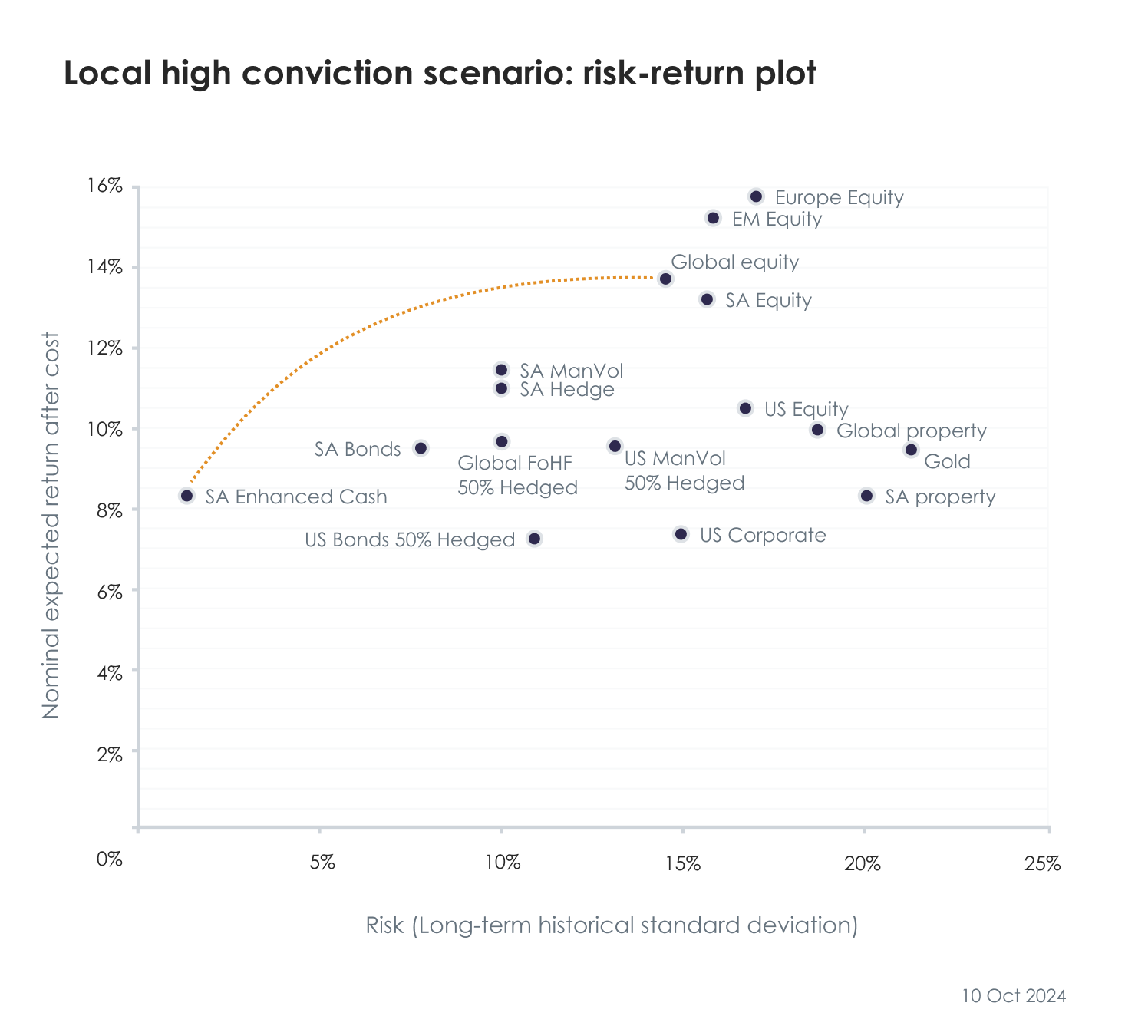
The chart below shows the three-year expected return versus the historical standard deviation of each asset class, based on our High Conviction scenario.
Source: Citadel
Near-Term Asset class views
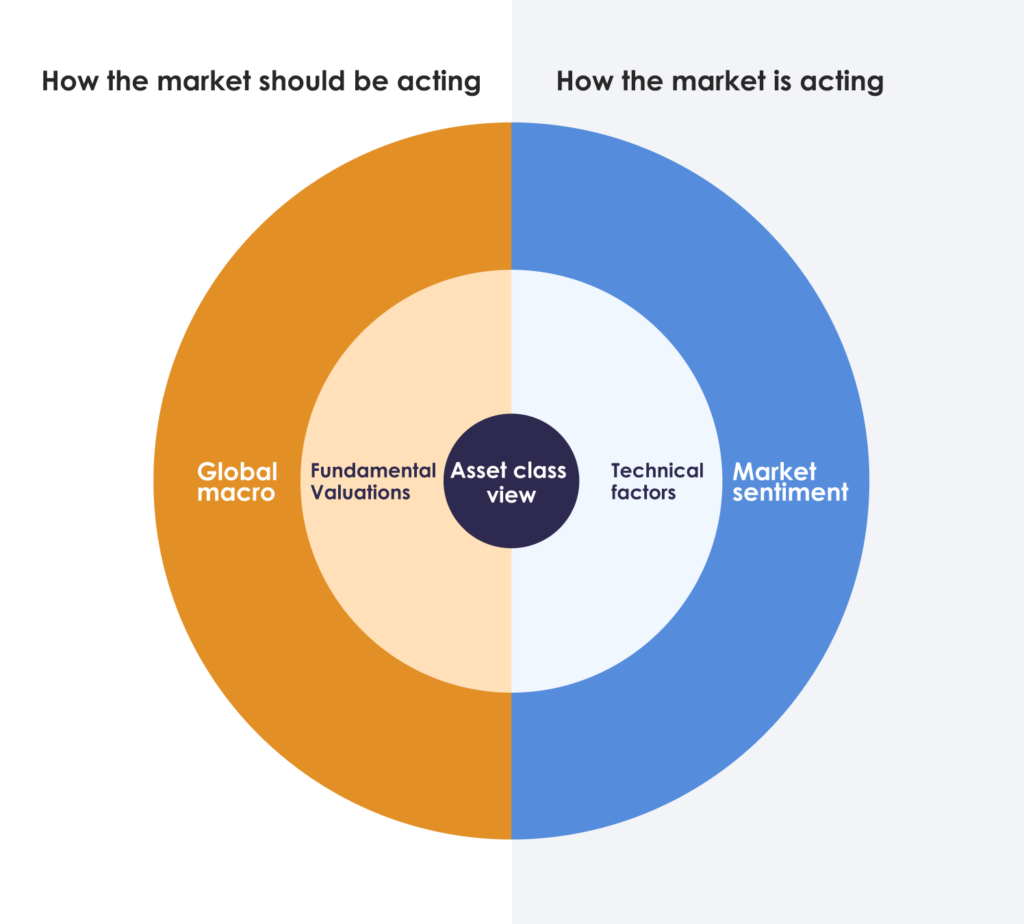
Our investment process is anchored by a High Conviction macroeconomic scenario and the corresponding expected returns for asset classes. This foundation helps us form expectations about how markets should behave. However, we are keenly aware that short-term market behaviour frequently deviates from these expectations. We’ve long recognised that medium-term, valuation-based signals often fail to predict short-term asset performance.
To address this, we’ve developed a range of tools and indicators to enhance our short-term analysis. These include a close examination of market dynamics, cross-asset, currency and commodity trends, market, and several other technical factors. These insights help us adapt our views and make more informed short-term decisions.
The diagram below visualises how these two parts of the process play into each other.
Source: Citadel
In addition to our top-down analysis, we integrate the bottom-up insights provided by our analysts. Their detailed research on individual companies and sectors plays a crucial role in shaping our overall views. When bottom-up analysis reveals strong fundamentals that contradict broader market signals, we adjust our stance accordingly. This dynamic approach allows us to balance macroeconomic factors with granular insights, ensuring our investment decisions reflect both the broader market environment and underlying asset strength.
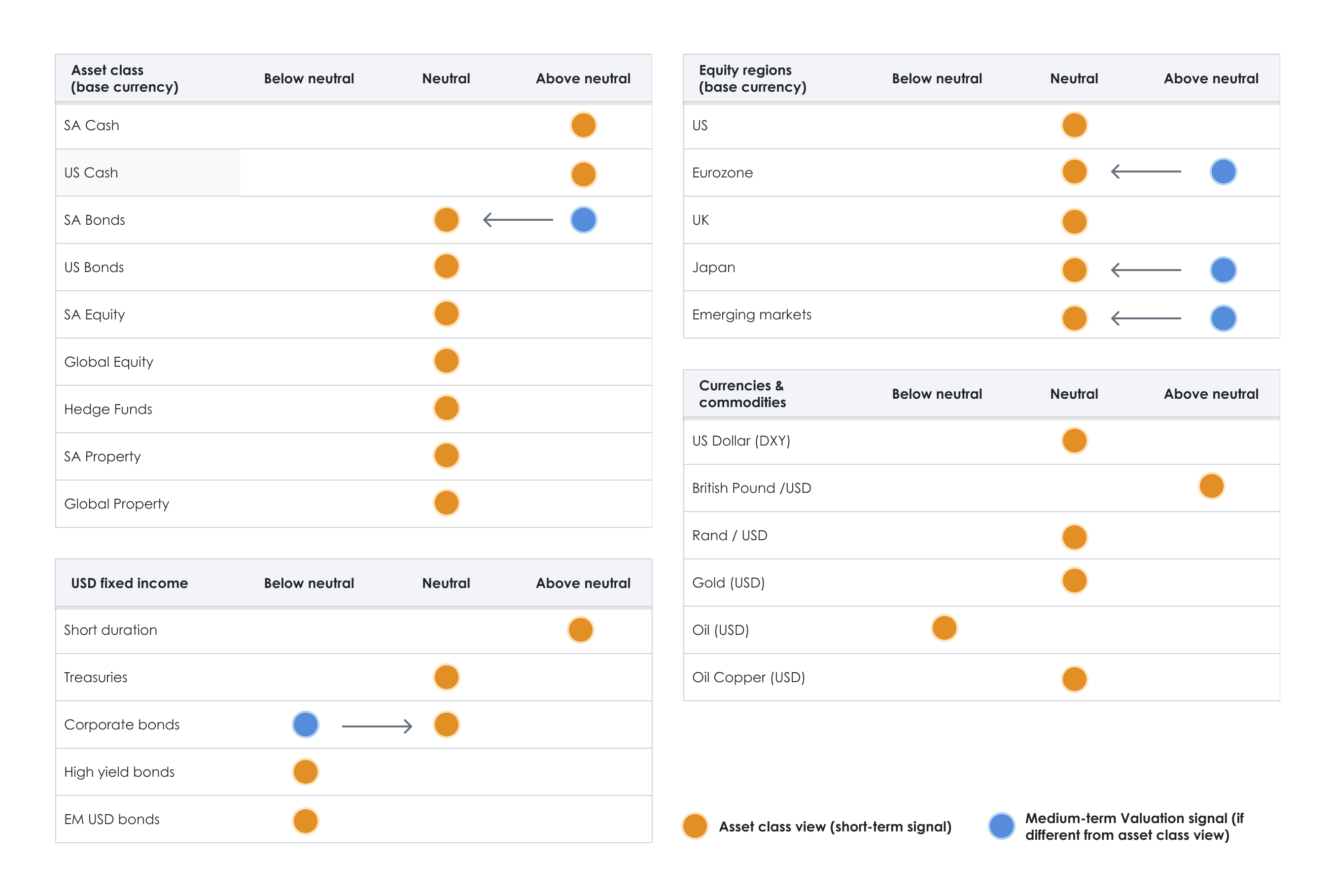
The following asset classes have a different short-term signal, to the medium-term fundamental valuation/expected return signals:
- SA government bonds rallied sharply post the May election and yields are below our fair value assumption; the short-term signal is neutral while the medium-term signal remains above neutral.
- US corporate bond spreads have narrowed to below our fair value assumptions and the medium-term signal is below neutral; however from a short-term perspective, spreads are expected to remain tight leaving the asset class at a neutral rating.
- European, Japanese, and emerging market equities are attractive from a valuation perspective and has a medium-term above neutral signal; from a shorter-term perspective it is marked down to neutral given the lack of earnings growth and still challenging economic landscape in parts these regions.
Our latest asset class views are summarised below.
Source: Citadel


