
Scenario modelling has formed part of Citadel’s investment philosophy for over two decades, and it enables us to better understand potential market outcomes and construct stronger portfolios. The Citadel Asset Management team has a core or “High Conviction” scenario based on a three-year view, which is expressed as macroeconomic and market assumptions, including economic growth, inflation, interest rates, price-earnings multiples, and credit spreads, to list a few. Based on these assumptions, our asset valuation models produce expected returns for various asset classes. This section is used to summarise our High Conviction view and the resulting asset signals.
High conviction scenario: medium-term expected returns
The global economy has navigated a period of heightened geopolitical uncertainty more effectively than many investors feared. Despite intermittent market volatility, our central expectation remains that global growth will remain close to long-term potential over the next three years. Inflation has moved somewhat higher in the near term, but is expected to moderate gradually over the projection horizon and converge towards central bank targets.
Central banks have adopted a more cautious tone in recent months as inflation has proven somewhat more persistent than expected. Market expectations for further policy tightening have increased in some regions, although our High Conviction scenario assumes the major central banks will remain on hold in the near term, with the Bank of Japan being the exception, where further hikes are expected. Government bond yields have moved higher and are above our fair value assumptions in most regions, supporting improved medium-term return expectations. Credit spreads remain near historically tight levels, reflecting resilient corporate fundamentals and generally healthy balance sheets.
The outlook for corporate earnings remains constructive. Recent earnings delivery has been robust and analysts continue to forecast strong profit growth over the coming years. The key question for investors is whether these elevated growth expectations can be sustained. While equity markets have de-rated on a forward earnings basis and valuations appear more reasonable than headline measures may suggest, our valuation framework assumes that strong earnings growth will need to materialise to justify current market levels. As a result, medium-term valuation signals across most equity markets have become more balanced.
South Africa’s (SA’s) outlook has benefited from a more stable global backdrop, although domestic challenges remain. Inflation has edged higher, but longer-term inflation expectations remain relatively well anchored. While there is some risk of further policy tightening, our central assumption remains that the South African Reserve Bank will keep rates unchanged in the near term. SA bond yields have declined and now trade below our fair value assumptions, while SA equities have produced a disappointing year-to-date return and remain exposed to the risk of further earnings downgrades. Despite these headwinds, both asset classes continue to screen broadly neutral within our valuation framework, while SA cash remains the most attractive of the major local asset classes.
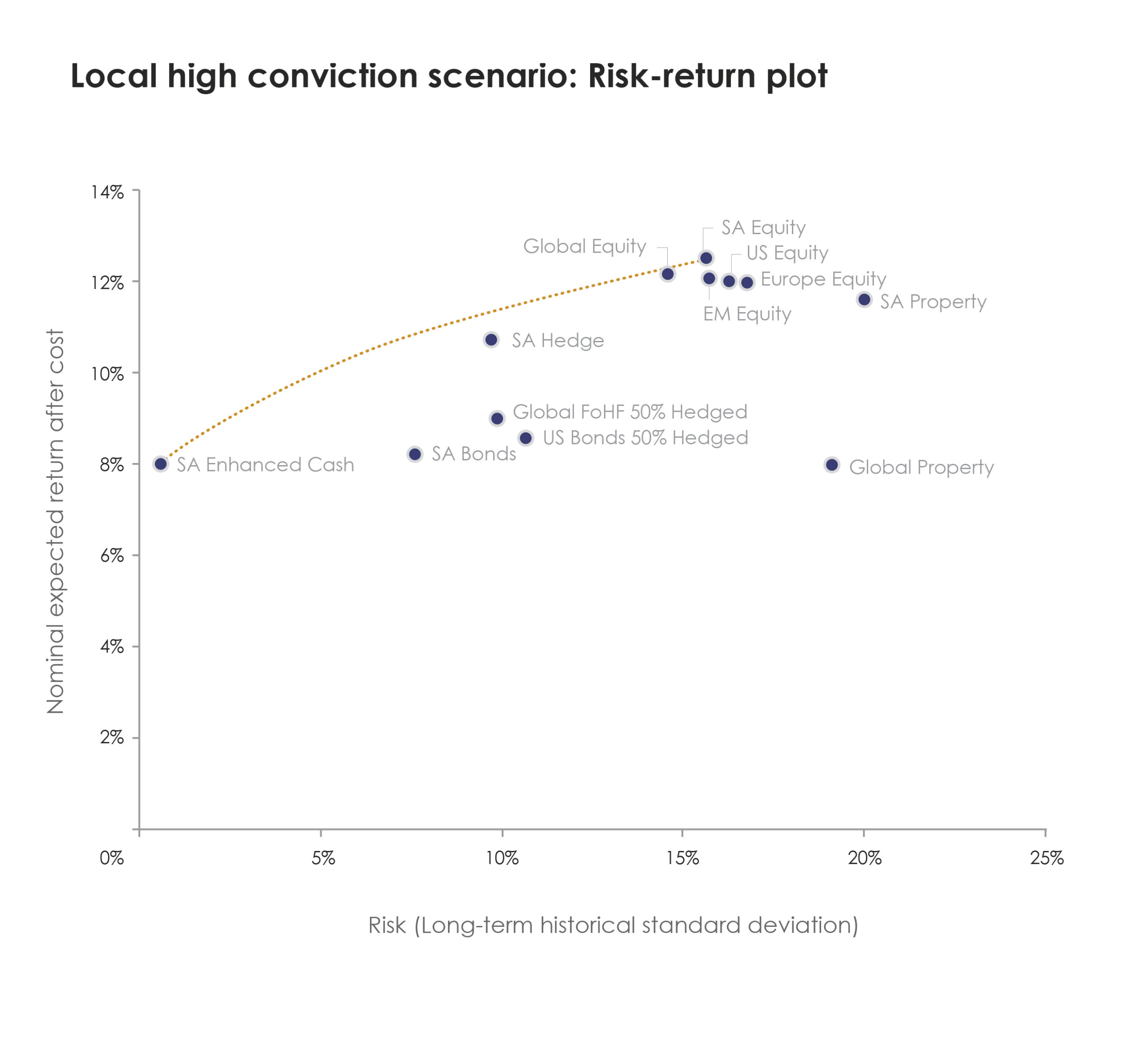
The chart below shows the three-year expected return versus the historical standard deviation of each asset class, based on our High Conviction scenario.
Near-term asset class views
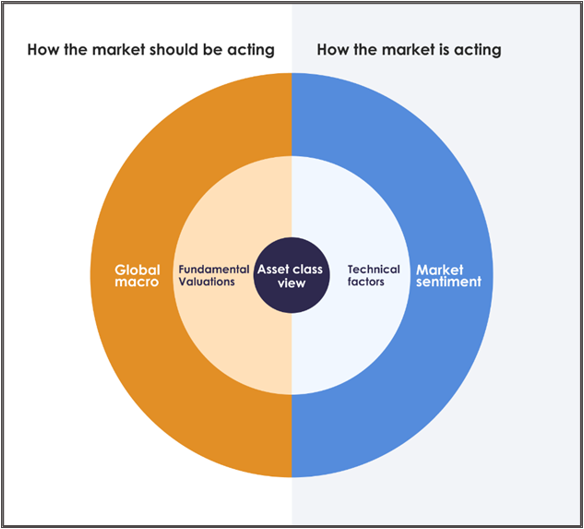
Our investment process is anchored by a High Conviction macroeconomic scenario and the expected returns it produces for various asset classes. While these medium-term valuation signals provide an important foundation for portfolio construction, market behaviour can diverge materially from fair value over shorter periods.
To complement our valuation framework, we incorporate a range of shorter-term indicators, including market dynamics, cross-asset relationships, currency trends and commodity signals. These tools help us identify opportunities and risks that may not yet be reflected in longer-term valuations.
The diagram below gives a visual representation of how these two parts of the process play into each other.
We also integrate the fundamental insights generated by our investment team. Detailed company and sector research helps refine our portfolio positioning and provides an important balance to broader market signals when bottom-up fundamentals differ from top-down expectations.
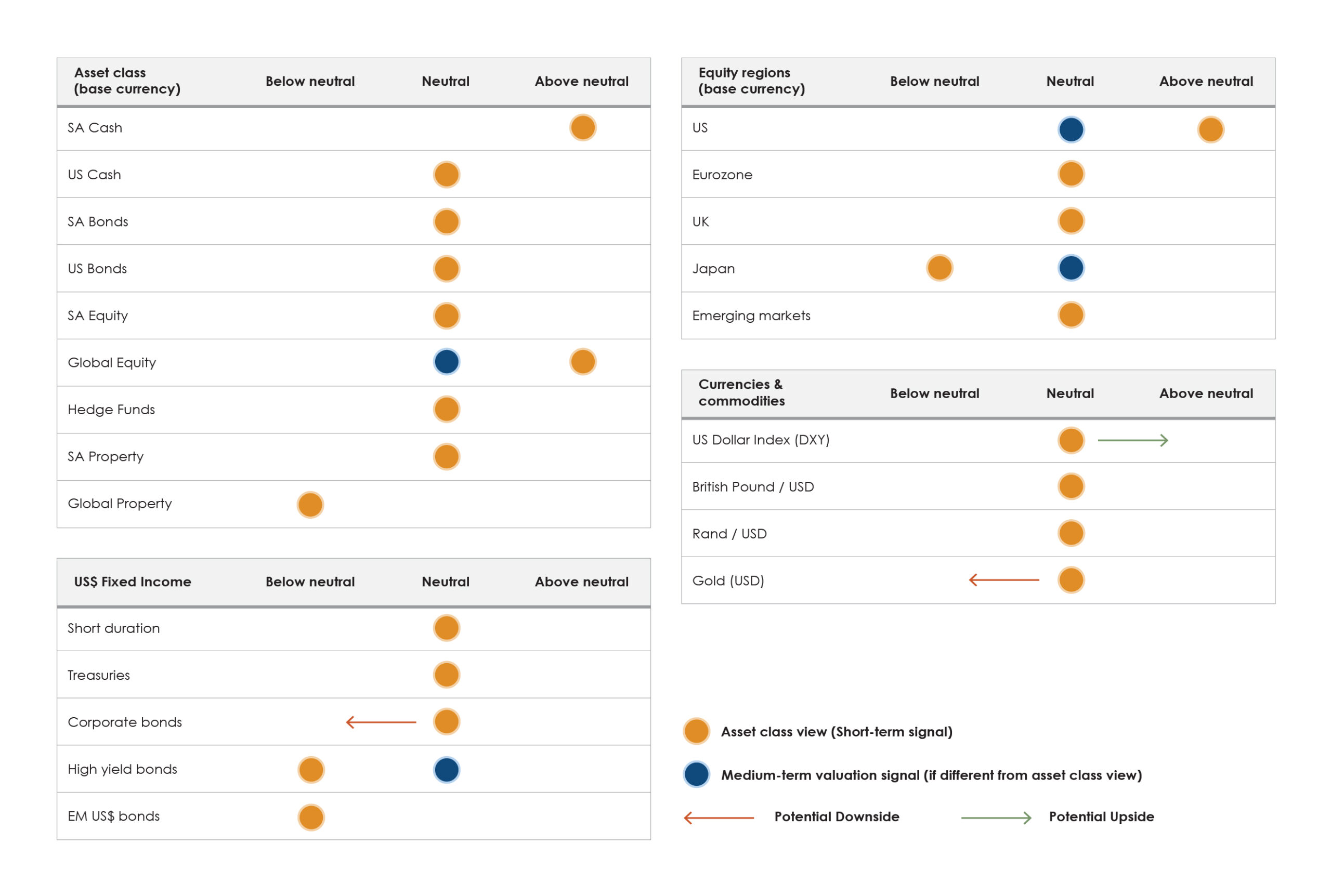
Our latest asset class views are summarised below. The orange blocks represent the short-term tactical views from the team, sometimes with an additional arrow if a Neutral view has more up or downside potential. Where the High Conviction scenario medium-term signals are different from the short-term views, it is indicated in blue. To determine the signal as Neutral or Above and Below, the model compares expected returns to what investors have historically required from these asset classes. For example, a Neutral Outlook implies a real expected return range of 1% to 3% for SA Cash, 2.5% to 5.5% for SA Bonds, and 4.5% to 9.5% for SA Equity. Views are expressed in the base currency of each asset class; currencies views are expressed separately.