


Inflation remains one of the most closely watched indicators in financial markets. It influences everything from interest rate expectations and bond yields to equity valuations and household purchasing power. Yet, despite its importance, inflation is often reduced to a single number – the annual change in the Headline Consumer Price Index (CPI). While this number provides a useful snapshot, it masks a far more nuanced and dynamic reality.
Inflation in South Africa is shaped by a complex interaction of domestic pressures, global developments, structural economic constraints, and consumption patterns across different income groups. These dynamics have become increasingly important in the current environment, where geopolitical tensions, global trade fragmentation, and commodity price volatility have reintroduced marked uncertainty into the inflation outlook. Therefore, understanding inflation requires going beyond Statistics South Africa’s (Stats SA) cited CPI figure.
The basket and what it holds: Who bears the burden?
South Africa’s CPI measures the average change in the prices of goods and services purchased by urban households. Stats SA constructs this measure using a representative basket of goods and services based on household spending patterns, which is periodically updated, most recently in January 2025, in line with the results of the Stats SA Income and Expenditure Survey, to ensure it reflects changing consumption behaviour and remains representative of actual household spending. The basket spans twelve broad categories, including food, housing, transport, education, insurance and financial services. Each category is assigned a weight that reflects its share of typical household expenditure, see Figure 1.
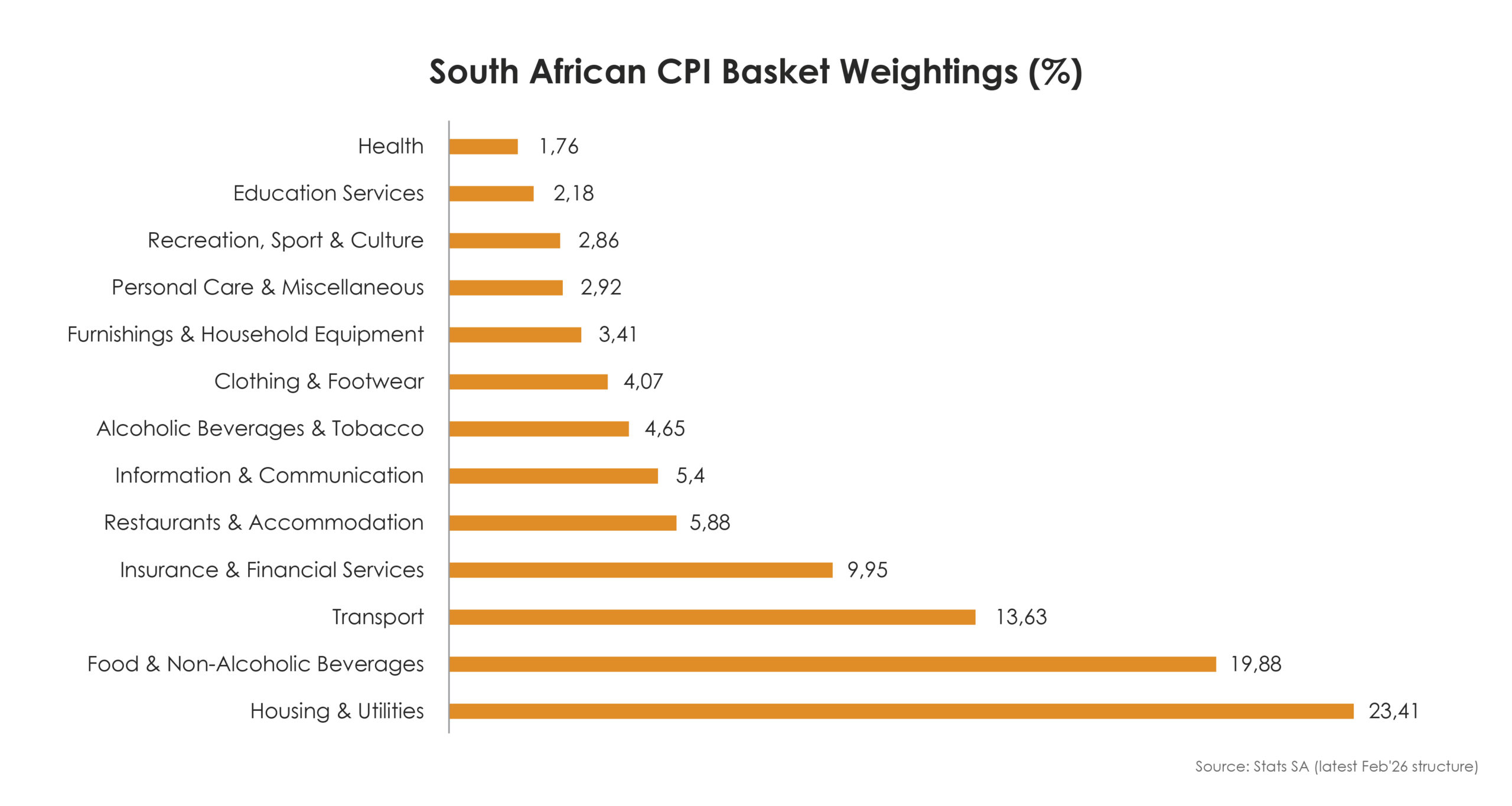
However, while the CPI basket provides a useful aggregate measure, it does not fully capture the differences in spending patterns across income groups. The basket is a composite, and the weighting scheme is plutocratic, meaning it reflects the total expenditures of all reference households, effectively giving a greater weight to the spending patterns of higher-income urban consumers simply because they spend more in absolute terms.
Higher-income households typically allocate a larger share of their income toward discretionary spending such as insurance, education, and recreation. By contrast, lower-income households spend more of their income on food, transport, and utilities, the very categories most exposed to global commodity price swings and administered price adjustments. As a result, inflation can vary significantly across households even when headline inflation remains stable.
For example, when food prices accelerate, as they did during the COVID-19 pandemic and more recently since 2025, driven by meat shortages linked to foot-and-mouth disease and rising input costs, lower-income households could experience inflation at a rate above the official headline figure. Similarly, a sharp increase in the price of illuminating paraffin, a primary energy source for many lower-income households, represents a disproportionate cost burden that never fully registers in the aggregate number.
Headline versus core inflation: Beneath the surface
Headline inflation often dominates market attention because it captures the full basket of goods and services, food, fuel, energy, services, and other consumer items, providing the most comprehensive measure of what households actually pay. Core inflation, by contrast, strips out food and non-alcoholic beverages, fuel and energy, which are highly volatile and heavily influenced by global commodity markets and exchange rate movements, factors beyond the reach of monetary policy. Therefore, core inflation aims to isolate the underlying, persistent trend in prices, thereby capturing the signal rather than the noise.
In South Africa, both measures have told a consistent story in recent years. Headline inflation averaged 4.4% through 2024 before declining to 3.2% for the full year 2025, its lowest annual average in over two decades. By February 2026, headline inflation moderated further to 3%, supported by declining fuel prices and a stronger rand. Core inflation has followed a similar trajectory. The convergence of headline and core prices near 3% signalled that disinflation was broad-based, rather than a temporary effect of falling fuel prices. However, in March, following the shock from the war in Iran, the South African Reserve Bank (SARB) changed its outlook, expecting inflation to rise on the back of higher oil and fertilizer prices, given supply shortages due to the blockage of the Strait of Hormuz in the Middle East.
From factory gate to shopping shelf: CPI vs PPI
Consumer inflation is often the downstream outcome of price pressures that first emerge further up the supply chain. The Producer Price Index (PPI) tracks prices received by domestic producers and serves as an early-warning indicator of potential consumer price movements.
When input costs rise at production level, manufacturers must either absorb the additional cost via lower profit margins or pass the higher cost on to consumers. In sectors with relatively thin margins, such as food processing, fuel distribution, and manufacturing, price increases typically flow through to the consumer within two to six months.
South Africa’s PPI has shown a broadly encouraging trend. After peaking in 2022/2023 amid the post-pandemic commodity surge, PPI has moderated significantly, easing pipeline pressures. By December 2025, PPI stood at 2.9%, largely driven by lower prices of food, beverages, tobacco, furniture, and other manufactured goods. By February 2026, it had fallen even further to 1.8%, reflecting sharply lower fuel prices. However, by March, due to the dramatically higher oil price, PPI had risen to 2.3%, see Figure 2.
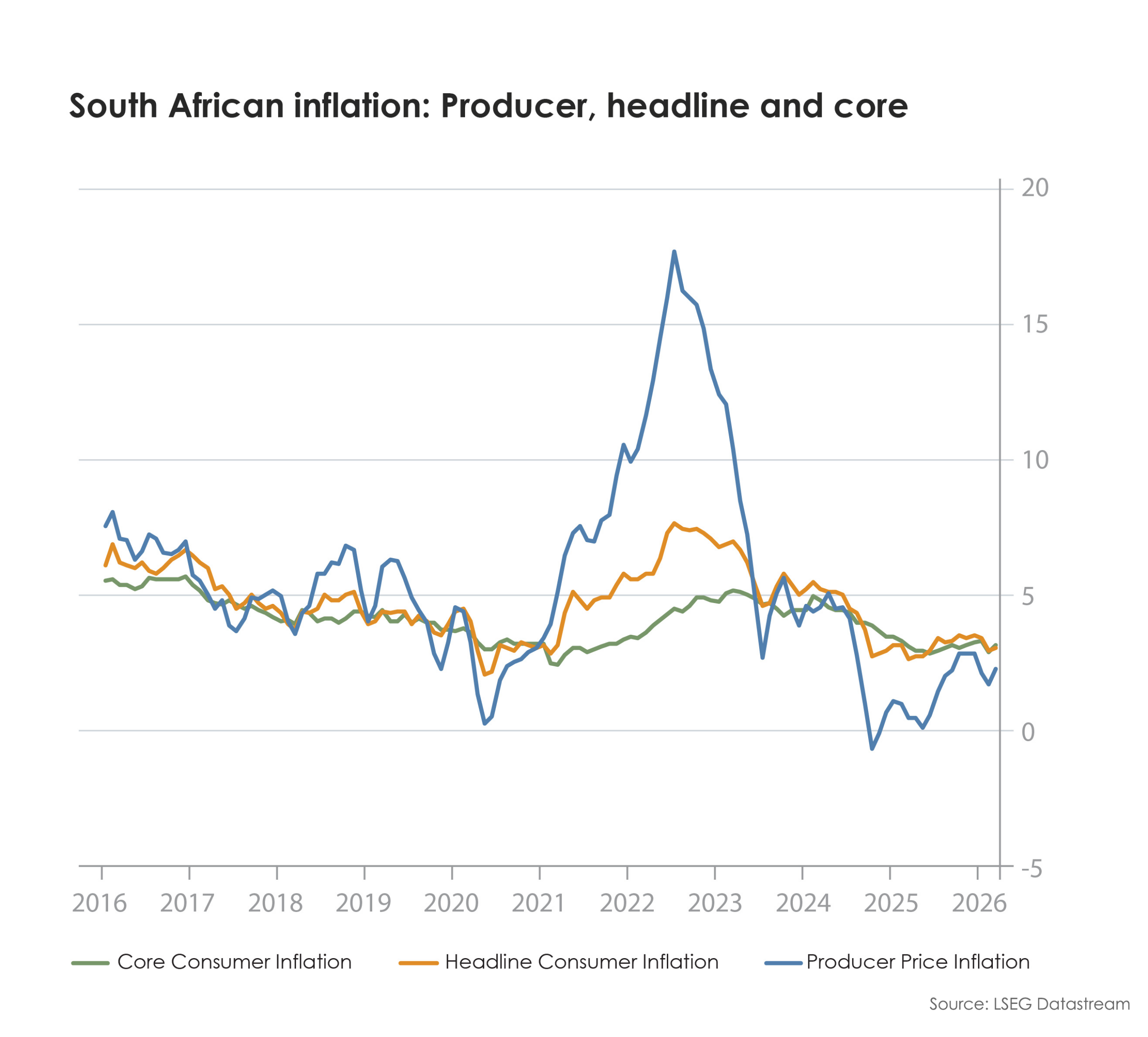
Figure 2
The new 3% inflation target and its implications
In July 2025, the SARB formally signalled a shift to a 3% inflation target with a one percentage point tolerance band around it, later confirmed by Finance Minister, Enoch Godongwana, in his February National Budget Speech. This marked a significant reduction from the previous 3% to 6% inflation target range. A credibly lower target should gradually compress the inflation risk premium in domestic government bond yields, reduce the cost of government borrowing, and allow South Africa’s broader interest rate structure to reprice downward over time. This implies that rand depreciation versus the United States (US) dollar, for example, should be lower going forward compared to history, given a smaller interest rate differential with the US.
There is, however, an important structural caveat. Unlike some advanced economies, which focus on core inflation to guide monetary policy, South Africa targets headline CPI. This means that administered price changes, including Eskom tariffs, municipal levies, and fuel adjustments, feed directly into headline CPI. The April 2026 fuel price increase on the back of the US-Israel war with Iran of over R3/litre illustrates this dynamic, mechanically lifting headline inflation even if underlying demand pressures, and hence, core inflation, remain subdued. Second-round cost pressures in agriculture, logistics, and manufacturing could feed through to consumer prices in the coming months, highlighting the ongoing importance of monitoring producer prices for price pressures in key sectors of the economy.
South Africa’s inflation path is also heavily influenced by external factors. As a small, open economy with a persistent current account deficit (we typically import more than we export), the country is exposed to global commodity cycles, exchange rate fluctuations, and supply chain disruptions. Commodity price movements affect both export revenues and the rand, while oil price increases flow directly into domestic fuel costs. The rand’s sensitivity to global risk appetite and capital flows amplifies these effects, with research from the SARB suggesting that exchange rate pass-through to consumer prices is meaningful and typically materialises over a six- to 12-month horizon.
These structural factors underscore the challenge of the new 3% headline CPI target. Anchoring inflation expectations lower could support a structurally lower interest-rate environment, but external shocks and administered price pressures mean that achieving this objective will require careful monitoring and disciplined policy execution.
Impact of geopolitics, oil, and the rand
The global environment that South Africa currently faces is materially more uncertain than it was in February, and the implications for the domestic inflation outlook are significant. The geopolitical tensions in the Middle East have introduced new inflation risks, due to supply chain disruptions, and conflict-related uncertainty resulting in increased volatility in commodity markets, especially oil, which remains particularly sensitive to supply disruptions. Higher oil prices quickly translate into higher fuel prices, which then can have a secondary impact on transport and food costs, which in turn could drive up inflation.
Brent crude oil’s price movements over the last two years, for example, highlight this issue. Having fallen from highs near $90/barrel in mid-2024, crude oil prices fell to lows close to $60/barrel in late 2025, on the back of global growth concerns and a production ramp-up by major producing nations. Escalating tensions in the Middle East, however, along with the disruption to shipping routes through the Strait of Hormuz, pushed Brent crude oil prices over $120/barrel in April 2026.
These effects are amplified by the economy’s reliance on imported fuel and exposure to exchange rate volatility. As such, the consequences of the war on South Africa’s fuel price were almost immediate. Finance Minister Godongwana described April’s adjustment in the fuel price as “a shock and a blow to the economy“. To soften the blow, he announced a temporary R3/litre reduction in the general fuel levy, through to early May, costing the economy R6 billion. Despite Godongwana’s subsidy the petrol price still increased by R3.06/litre for both 93 and 95 octane grades, and by a staggering R7.37/litre for diesel. The rand’s depreciation against the US dollar during March, from around R16 to above R17 per US dollar, compounded the impact of higher oil prices, adding significantly to the rise in fuel prices, including paraffin
Citadel’s outlook: Inflation and policy implications
For South Africa, the war’s oil shock is expected to lift inflation in the near term through higher fuel, transport and food costs, with headline inflation likely to rise towards 4%, despite starting the year near the SARB’s 3% target. While the SARB is expected to look through first‑round energy effects, risks to the inflation outlook have shifted to the upside and inflation is now expected to remain more volatile in the short term, before gradually easing back towards target, assuming energy prices stabilise and any second‑round effects are contained.
Prior to the escalation of the conflict in the Middle East, South African markets priced in two to three cuts in domestic short-term interest rates for the next 12 to 18 months. However, on the back of the war, and the rise in energy prices, financial markets have priced out any cuts in the current cycle and are anticipating upward pressure on interest rates domestically going forward.
Citadel’s cash‑flow assumptions
When it comes to how Citadel manages its clients’ wealth, it is important to highlight the assumptions we use when conducting cash‑flow analysis for clients. Despite, the influences of events like the war and the SARB’s 3% inflation target, we continue to assume a long‑term inflation rate of 6%. While the SARB may be targeting lower inflation outcomes, we believe it is prudent to build in an additional margin of safety when doing financial planning. Using a slightly higher inflation assumption provides a more conservative and realistic framework for long‑term planning.
In addition, our assumption for medical inflation is materially higher than headline inflation and sits closer to 10%. This reflects two realities: firstly, medical-cost inflation has consistently exceeded general consumer inflation over time; and secondly, clients’ healthcare expenditure typically increases as they age.
Our assumed real return of approximately 2.5% per annum above inflation is also intentionally conservative. This is lower than both actual portfolio outcomes and long‑term historical asset class performance. The purpose of this assumption is to ensure that the cash‑flow modelling process errs firmly on the side of caution. Collectively, these assumptions are designed to keep our cash‑flow analysis conservative and robust, and to give us a high level of confidence in the long‑term sustainability of clients’ capital under realistic real‑world conditions.


